The Best European Christmas Markets to Visit with Kids: A Family Guide to Holiday Magic
A seasoned mom's guide to the best European Christmas markets for families, from Nuremberg to Budapest. What to eat, what to wear, kid-friendly activities, budgeting tips, and multi-city itineraries to make the most of holiday travel with children.
Disclosure: Some links below are affiliate links. As an Amazon Associate I earn from qualifying purchases, and may earn from Booking.com, Mavely, and CJ partner links at no extra cost to you.
This post contains affiliate links. If you purchase through these links, we may earn a small commission at no extra cost to you. See our full disclosure policy.
There is nothing quite like stepping into a European Christmas market with your kid for the first time. The smell of roasted almonds drifting through cold air. Tiny wooden stalls glowing with warm light. Your child pointing at a carousel spinning slowly under a canopy of stars. I remember standing in the middle of Nuremberg's Christkindlesmarkt with Lila on my hip when she was three, snow dusting her red hat, and thinking: this is the kind of memory that stays.
European Christmas markets are one of the most magical winter travel experiences you can share with your family, and I've spent years visiting them with Lila at every age and stage. Some are enormous and famous. Others are tucked into cobblestone squares in smaller cities where you might be the only tourist family. All of them are worth the trip if you plan ahead.
This guide covers the best Christmas markets in Europe for families, what to expect at each one, what your kid will eat (and love), what to wear, how to budget, and how to combine several markets into one unforgettable trip.

Cold-weather kit for Christmas-market season
Lila lives in her Béis weekender bag — same one I bring. For lodging the markets I start with family hotels in Munich and pivot from there.
- EBAGS packing cubes — wool sweaters compress; hers and mine in separate cubes.
- Columbia insulated boots — the ones that survived two seasons of slush.
- universal travel adapter — Type F for Germany and Austria, no swap-out needed.
- reusable water bottle — insulated, doubles as a glühwein-cooldown holder on the walk back.
Why Visit a European Christmas Market with Kids
If you've ever wondered whether dragging a small child across an ocean in December is worth it, the answer is an emphatic yes. Christmas markets in Europe are built for lingering, for wandering, for stopping every few steps because something new has caught your child's eye. Unlike theme parks or museums where you're always moving toward the next thing, markets let you slow down. You stand in one spot and sip something warm. Your kid presses their nose against a glass case full of hand-painted ornaments. Nobody is rushing you.
Most markets are free to enter. The food is affordable. The entertainment, from puppet shows to live nativity scenes to small rides and games, is either free or costs a couple of euros. And the atmosphere is something your kid will remember for years. Lila still talks about the wooden nutcracker she picked out in Vienna when she was five. It sits on her dresser every December.
The Best Christmas Markets in Europe for Families
Nuremberg Christkindlesmarkt, Germany
Nuremberg is the gold standard of Christmas markets, and it deserves that reputation. The Christkindlesmarkt fills the main square of this medieval Bavarian city with nearly 200 wooden stalls selling handmade ornaments, gingerbread, toys, and more. It has been running since the 1500s, and walking through it feels like stepping back in time.
For families, Nuremberg is outstanding. There's a dedicated Children's Christmas Market (Kinderweihnacht) right next door with a carousel, a small Ferris wheel, and craft stations where kids can make their own candles and ornaments. Lila spent an entire afternoon there while I browsed the main market stalls, which was the kind of divide-and-conquer parenting that works beautifully on vacation.
The famous Nuremberg gingerbread (Lebkuchen) is softer and spicier than what you find elsewhere, and kids tend to love it. Look for the stalls selling fresh Lebkuchen in decorative tins, which make perfect gifts to bring home. The Nuremberg bratwurst is smaller and thinner than other German sausages, grilled over beechwood, and served three to a roll. Even picky eaters usually approve.
Pro tip: Nuremberg's market opens on the Friday before the first Sunday of Advent and runs through Christmas Eve. The opening ceremony, where the Christkind (a young woman dressed as a golden angel) recites a prologue from the balcony of the Church of Our Lady, is genuinely breathtaking. Arrive early to get a good viewing spot with kids.
Vienna Christmas Markets, Austria
Vienna doesn't have one Christmas market. It has dozens, scattered across the city like ornaments on a tree. The largest and most famous is the Rathausplatz market in front of City Hall, where an enormous advent calendar counts down the days on the building's facade and a sprawling ice skating rink wraps around the park. This is the market that lands on every magazine cover, and for good reason. It's spectacular.
But for families, I actually prefer the smaller markets. The Schonbrunn Palace market has a more intimate feel, with the palace lit up behind you and fewer crowds pressing in. The Spittelberg market in the narrow cobblestone streets of the seventh district is charming and manageable with a stroller. And the Am Hof market focuses on arts and crafts, with artisans working at their stalls, which fascinates older kids.
Vienna's market food is exceptional. Try the Kartoffelpuffer (crispy potato pancakes), Maroni (roasted chestnuts), and Kaiserschmarrn (shredded pancakes with powdered sugar). For kids who want something warm to drink, ask for Kinderpunsch, which is a non-alcoholic version of the mulled wine that adults are sipping from mugs shaped like boots and stockings.

Strasbourg Christkindelmarik, France
Strasbourg calls itself the Capital of Christmas, and after visiting, I'm not inclined to argue. This Alsatian city on the French-German border has been hosting its market since 1570, making it one of the oldest in Europe. The entire city center transforms into a Christmas village, with markets spread across multiple squares and a massive tree towering over Place Kleber. Geneviève, my Paris translator friend, considers it the only French Christmas market worth the trip and she has very strong opinions on the rest.
What makes Strasbourg special for families is the way the whole city participates. Nearly every building in the old town (the Grande Ile, which is a UNESCO World Heritage site) is decorated with lights and garlands. Walking through the half-timbered streets with your kid feels like being inside a storybook. The Petite France neighborhood along the canals is particularly magical after dark.
The food here blends French and German traditions in the best possible way. Try bredele (small Alsatian Christmas cookies in dozens of varieties), flammekueche (a thin-crust pizza-like flatbread with cream, onions, and bacon), and pain d'epices (spiced gingerbread). The hot chocolate at many stalls is made with real melted chocolate and is possibly the best thing your child will taste on the entire trip.
Prague Christmas Markets, Czech Republic
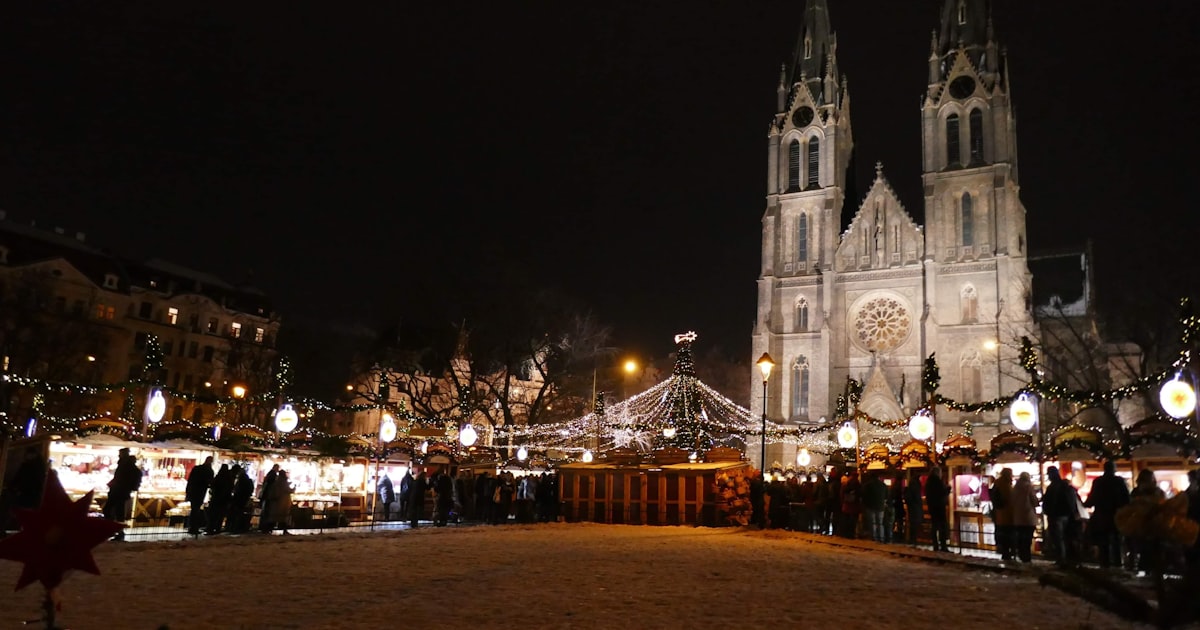
Prague is one of the most affordable Christmas market destinations in Europe, which makes it a smart choice for families watching their budget. The main market in Old Town Square sits beneath the twin spires of the Tyn Church, with a massive tree and a wooden stage hosting live performances throughout the day. There's also a large market in Wenceslas Square, about a ten-minute walk away.
Prague's markets are famous for Trdelnik, a sweet rolled pastry cooked over charcoal and coated in sugar and cinnamon. Every child I have ever seen encounter Trdelnik for the first time has reacted with pure joy. It's warm, crispy on the outside, soft on the inside, and you can get it filled with ice cream, Nutella, or whipped cream. Is it traditional Czech food? That's debatable. Is it delicious? Absolutely.
Beyond the markets, Prague itself is a fantastic city for families in winter. Prague Castle is mesmerizing in the snow. The astronomical clock in Old Town Square puts on a show every hour. And the overall cost of meals, accommodation, and activities is significantly lower than in Western European cities.
Copenhagen Tivoli Gardens, Denmark
Tivoli Gardens transforms into a winter wonderland starting in mid-November, and it's unlike any other Christmas market experience in Europe. This is partly because Tivoli is an amusement park, so along with the Christmas stalls and food, you also get rides, games, and shows. For families with kids who might get restless at a traditional market, Tivoli solves that problem completely.
The park is decorated with hundreds of thousands of lights, and walking through it at night is genuinely enchanting. There's an ice skating rink, a Christmas-themed funhouse, and gentle rides for small children alongside bigger thrills for older kids. The Nutcracker performance in the Tivoli Concert Hall is a holiday tradition worth booking in advance.
Copenhagen is an expensive city, and Tivoli reflects that with higher entry and food prices than other markets on this list. But the experience is so unique and so well suited to families that I think it justifies the cost, especially if you buy tickets online in advance for a discount.
Cologne Christmas Markets, Germany
Cologne has not one but seven major Christmas markets, each with its own character. The most famous is the market at the foot of the Cologne Cathedral (Kolner Dom), where the towering Gothic church provides what might be the most dramatic backdrop of any Christmas market in the world. Standing in front of those massive spires with market lights reflecting off the stone is an experience that will give you chills that have nothing to do with the temperature.
For families, the Rudolfplatz market (sometimes called the Nikolausdorf or Nicholas Village) is worth seeking out. It has a child-friendly layout, a small ice rink, and a bakery where kids can decorate their own gingerbread. The Alter Markt in the Old Town is another good pick, with a stage hosting live music and a cozy, enclosed feel.
Cologne is also easy to reach and combine with other German markets. It's a major rail hub, so you can take day trips to Aachen or Bonn, both of which are excellent and less crowded than Cologne.
Budapest Christmas Fair, Hungary
Budapest's main Christmas market at Vorosmarty Square is compact, beautiful, and extremely affordable. Hungary is one of the best-value destinations in Europe, and that extends to the Christmas markets. You can feed a family of four at the market stalls for what a single meal might cost in Zurich or Copenhagen.
The food at Budapest's market is a highlight. Try langos (deep-fried dough topped with sour cream and cheese), chimney cake (kurtoskalacs), and Hungarian goulash served in a bread bowl. The chimney cake is especially fun for kids to watch being made. The dough is wrapped around a wooden cylinder, rolled in sugar, and slowly rotated over coals until it's golden and crispy.
Budapest itself is magical in December. The thermal baths are perfect for warming up after a morning at the markets, and kids are welcome at several of them including the Szechenyi Baths, which have outdoor pools that steam dramatically in the cold air. The views along the Danube at night, with the Parliament building and Buda Castle lit up, are among the most beautiful in Europe.
Bruges Christmas Market, Belgium
Bruges is a small city, and its Christmas market matches that scale, which is part of its appeal. The market in the Markt (main square) and Simon Stevinplein is intimate and manageable, surrounded by medieval buildings and the famous Belfry tower. For families who find the mega-markets overwhelming, Bruges is a breath of fresh air.
There's an ice rink in the main square, and the whole city is decorated with lights that reflect off the canals. A boat tour through the illuminated canals after dark is an experience your kid will not forget. The Belgian hot chocolate is, predictably, outstanding, and the waffle stands serve both Liege-style (dense, sweet, caramelized) and Brussels-style (lighter, crispier) waffles that kids devour.
Bruges is also an easy day trip or weekend trip from Brussels, Paris, or London (via the Eurostar to Brussels and then a one-hour train ride), which makes it perfect for combining with other destinations. Quick warning while we're here: pickpockets at the Eurostar arrival hall at Gare du Nord work the December crush hard. Eyes up. They love a coat with deep pockets and a parent juggling two paper cups of hot chocolate.

What to Eat and Drink at European Christmas Markets
Foods Your Kids Will Love
One of the best things about Christmas markets is that the food is inherently kid-friendly. Most of it is handheld, sweet or savory comfort food, and served fresh and hot. Here are the must-tries across different countries:
Bratwurst (Germany and Austria): Grilled sausages served in a roll, sometimes with mustard or ketchup. Simple, satisfying, and available at nearly every stall. Nuremberg's smaller bratwurst are especially good for small hands.
Chimney cake / Trdelnik / Kurtoskalacs (Czech Republic, Hungary, and increasingly everywhere): Sweet rolled dough cooked over coals. Crunchy outside, pillowy inside. Can be filled or topped with chocolate, nuts, or cinnamon sugar.
Crepes and waffles (France, Belgium): Thin crepes with Nutella, or thick Belgian waffles with powdered sugar. Classic for a reason.
Roasted chestnuts (Maroni): Available everywhere. The smell alone is part of the Christmas market experience. Peel them while they're still warm.
Kartoffelpuffer / Reibekuchen (Germany, Austria): Crispy potato pancakes served with applesauce or sour cream. These disappear off a plate faster than you can order a second round.
Lebkuchen (Germany): Soft, spiced gingerbread cookies, often decorated and sold in tins. Makes a great edible souvenir.
What About Drinks
Adults will want to try Gluhwein (mulled red wine) and Feuerzangenbowle (mulled wine with a rum-soaked sugar cone melted over it), but kids have their own options. Kinderpunsch is the go-to non-alcoholic hot drink at German and Austrian markets, made with fruit juice, spices, and sugar. It's basically warm, spiced apple or berry juice, and kids adore it. Most markets also serve excellent hot chocolate, and you can usually find warm apple cider as well.
A THERMOS FUNTAINER kids water bottle is a lifesaver at the markets. Pour in some Kinderpunsch or hot chocolate and your little one has a warm drink that stays at a safe temperature for hours as you wander.
When to Visit European Christmas Markets
Timing matters more than you might think. Most Christmas markets across Europe follow a similar schedule:
Opening: Most markets open in the last week of November, often around November 23-25. Some, like Tivoli in Copenhagen, open as early as mid-November. Strasbourg and Nuremberg typically open on the Friday before the first Advent Sunday.
Closing: Most markets close on December 23 or 24. A few extend through New Year's, but the majority shut down by Christmas Eve.
Best time for families: Visit in late November or the first two weeks of December. Markets are fully open and stocked, the holiday atmosphere is in full swing, but the crush of crowds that hits during the final week before Christmas hasn't yet arrived. Weekday visits are significantly less crowded than weekends. If you can travel on a Tuesday or Wednesday, you'll have a much more relaxed experience with kids.
Worst time: The last weekend before Christmas is the busiest time at virtually every market. Strollers become nearly impossible to navigate, wait times for food stretch long, and the overall experience with small children can tip from festive to stressful. Skip it. Trust me.
What to Wear and Pack for Christmas Markets with Kids
December in Europe means cold, and when you're standing outdoors for hours browsing market stalls, that cold gets into your bones. Dressing your kid properly is the difference between a magical day and a miserable one. Here's what I've learned through trial and plenty of error:
Layers Are Everything
The layering system works: a moisture-wicking base layer, a warm fleece or wool mid-layer, and a waterproof outer shell. Cotton is the enemy in cold weather because it holds moisture and chills your kid fast. Invest in wool or synthetic base layers for everyone.
Footwear
Cold, wet feet will end your Christmas market day faster than anything else. Your kid needs waterproof insulated winter boots that they have broken in before the trip. Cobblestones can be slippery when wet or icy, so look for boots with good traction. And pack extra wool socks. You will need them.
Hands and Extremities
Little fingers get cold fast, especially when they're reaching for food and taking off gloves repeatedly. Pack a pair of waterproof Thinsulate kids gloves for each child, and then throw a few packs of HotHands hand warmers into your bag. Tuck one inside each glove or jacket pocket and your kid will stay warm for hours. They're lightweight, TSA-friendly, and I consider them an absolute non-negotiable for winter travel with children.
Don't forget warm hats that cover the ears, a scarf or neck gaiter for each child, and consider fleece-lined leggings or snow pants for toddlers and preschoolers who might end up sitting on cold ground.
What Else to Pack
Beyond clothing, a few other items will make your Christmas market trip smoother:
A slim portable phone charger is essential. You'll be taking hundreds of photos, using maps, and your phone battery drains faster in cold weather. This compact power bank fits in a coat pocket and charges fast.
A good set of packing cubes will save your sanity when you're managing winter wardrobes out of suitcases. Separate each layer, accessory, and PJ into their own cube so mornings aren't a frantic dig through a shared bag.
A packable rain cover for your stroller (if you're bringing one), small reusable bags for carrying market purchases, and a basic first aid kit are also worth tossing in your luggage.
Budgeting for a Christmas Market Trip
One of the wonderful things about Christmas markets is that the core experience - walking through the stalls, listening to music, soaking in the atmosphere - is completely free. Your spending will come from food, drinks, and any gifts or souvenirs you buy. Here is a rough breakdown of what to expect:
Food and drinks: A bratwurst in a roll costs around 3-€5 in most markets. Trdelnik or chimney cake runs 4-€6. Hot chocolate or Kinderpunsch is 3-€4 (plus a mug deposit of 2-€4 that you get back). A family of four can eat well at the markets for 30-€50 per visit.
Souvenirs: Handmade ornaments range from 5-€25. Wooden toys start around €10. Nutcrackers and music boxes can be pricier, 20-€80 depending on quality. Set a budget per child for picking out a special ornament or toy and stick to it.
Rides and activities: Carousels and small rides usually cost 2-€4 per child. Ice skating runs 5-€10 including skate rental. Craft activities at the children's markets are often 3-€8.
Budget-friendly destinations: Prague and Budapest are your best bets for keeping costs low. Food, drinks, and activities at their markets cost roughly half of what you would pay in cities like Vienna, Copenhagen, or Zurich. Accommodation is also significantly cheaper in Eastern European cities.
Splurge-worthy destinations: Copenhagen (Tivoli) and Vienna are more expensive but offer experiences that feel worth the extra cost, especially if you plan ahead and book accommodation early.
Combining Multiple Markets into One Trip
Some of the best Christmas market itineraries connect multiple cities by train. Europe's rail network makes this easier than you might think, and traveling by train with a kid is infinitely more pleasant than dealing with rental cars and winter driving conditions. (I've used Eurail four times now. The night-train sleeper between Vienna and Berlin is still the secret weapon nobody talks about.) Three itineraries I recommend:
The German Triangle (7-10 days)
Fly into Frankfurt. Take the train to Nuremberg (2 hours) for two to three days. Then head to Cologne (4.5 hours, or break it up with a stop in Wurzburg) for two to three days. Finish in Strasbourg (1.5 hours from Cologne by high-speed train), which is technically France but feels like a bridge between both countries. Fly home from Strasbourg or take the train back to Frankfurt.
The Central European Loop (10-14 days)
Fly into Vienna for three to four days of Christmas markets and imperial grandeur. Train to Budapest (2.5 hours) for two to three days of affordable markets and thermal baths. Train to Prague (6.5 hours, or break it up with a stop in Bratislava) for two to three days. This itinerary gives you three countries, three very different market traditions, and significant savings in Budapest and Prague that offset Vienna's higher prices.
The Western Europe Weekend-Hopper (5-7 days)
For families with limited time, fly into Brussels. Day-trip to Bruges (1 hour by train) for the market and Belgian chocolate. Take the high-speed train to Cologne (under 2 hours) for a full day of cathedral markets. Or head south to Strasbourg (various routes, about 4 hours) for the Alsatian experience. This works well as a long weekend or a short school-break trip.
Practical Tips from One Mom to Another
After years of doing this with Lila, here are the things I wish someone had told me before our first Christmas market trip:
Visit markets in the late afternoon and evening. The lights are the whole point. Markets that look pleasant during the day become genuinely magical after 4 PM when everything is lit up. Plan for an early rest or nap so your kid has energy for the evening.
Bring a carrier for toddlers, not just a stroller. Cobblestones are brutal on strollers. Crowds make stroller navigation stressful. A structured baby carrier keeps your toddler warm against your body and gives you both hands free for food and shopping.
Let your kid pick one special ornament per market. This becomes a family tradition that compounds over the years. By the time they're a teenager, they will have a collection of ornaments from markets across Europe, each one attached to a memory. Label the back with the city and year. Lila has eight so far. Eight years' worth of December excitement.
Learn a few phrases in the local language. Even simple things like please, thank you, and one bratwurst please delight stall vendors and model good travel behavior for your kid.
Hotel rooms with kitchenettes save money. Eating every meal out adds up fast. Book accommodation with at least a small fridge and microwave so you can do breakfast and some lunches in the room, then save your food budget for splurging at the markets.
The mug deposit system. At German and Austrian markets, your Gluhwein or Kinderpunsch comes in a keepsake mug with a deposit (Pfand) of 2-€4. You can return the mug for your deposit, or keep it as a souvenir. We keep one mug from each market we visit, and they have become some of our favorite holiday decorations at home.
One last thing: go slowly. The whole point of a Christmas market is to linger. Don't try to see everything. Don't rush from stall to stall checking things off a list. Find a spot near a fire pit or a warm stall, order something hot, and just stand there with your family, watching the lights and listening to the music. That is the real magic, and your kid will feel it too.

Family Travel Essentials
My tried-and-tested picks for this trip:
Recommended Products
SOREL Kids Snow Commander Waterproof Winter Boots
Waterproof anti-slip warm cozy faux fur lined outdoor winter boots for kids
View on Amazon
HotHands Hand Warmers 40-Pair Pack
Long lasting natural odorless air activated hand warmers - up to 10 hours of heat
View on Amazon
THERMOS FUNTAINER 12oz Kids Stainless Steel Water Bottle
Vacuum insulated stainless steel kids water bottle with straw - keeps drinks cold or hot for hours
View on Amazon
N'Ice Caps Kids Waterproof Winter Thinsulate Gloves
Waterproof winter gloves with Thinsulate insulation and knit cuff for kids
View on Amazon
Amazon Essentials 4-Piece Packing Cubes Set
4-piece packing cubes travel accessories set with double zipper and mesh top - small, medium, large, slim
View on AmazonEpicka Universal Travel Adapter
Ultra slim 45W fast charging power bank with USB-C cable - flight safe travel essential for keeping phones charged
View on Amazon* Affiliate links: We may earn a commission from purchases made through these links, at no extra cost to you. See our full disclosure.